
The Importance of Composition in Painting: My Journey from Chaos to Collector Editions
Composition is the silent architecture of every great painting.
It is the invisible structure that holds emotion, color, and meaning together. Without it, even the most beautiful colors can feel lost. With it, a painting becomes powerful, balanced, and timeless.
When I first began painting seriously, I didn’t fully understand this truth.
I painted from emotion. From instinct. From a deep need to express myself.
But I paid very little attention to composition.
Today, I understand that composition is everything — and also something that can never be perfectly mastered.
Let me explain.

What Is Composition in Painting?
Composition is the way elements are arranged within a painting.
It includes balance, movement, depth, focal points, color harmony, and spatial relationships.
A strong composition guides the viewer’s eye naturally across the canvas.
A weak composition can leave the viewer feeling disconnected, even if the colors are beautiful.
Composition determines whether a painting feels calm or chaotic, powerful or passive, complete or unfinished.
And yet — composition is also deeply personal and subjective.
The Difference Between Abstract, Landscape, and Portrait Composition
Each genre of painting approaches composition differently. Understanding these differences is essential for both artists and collectors.
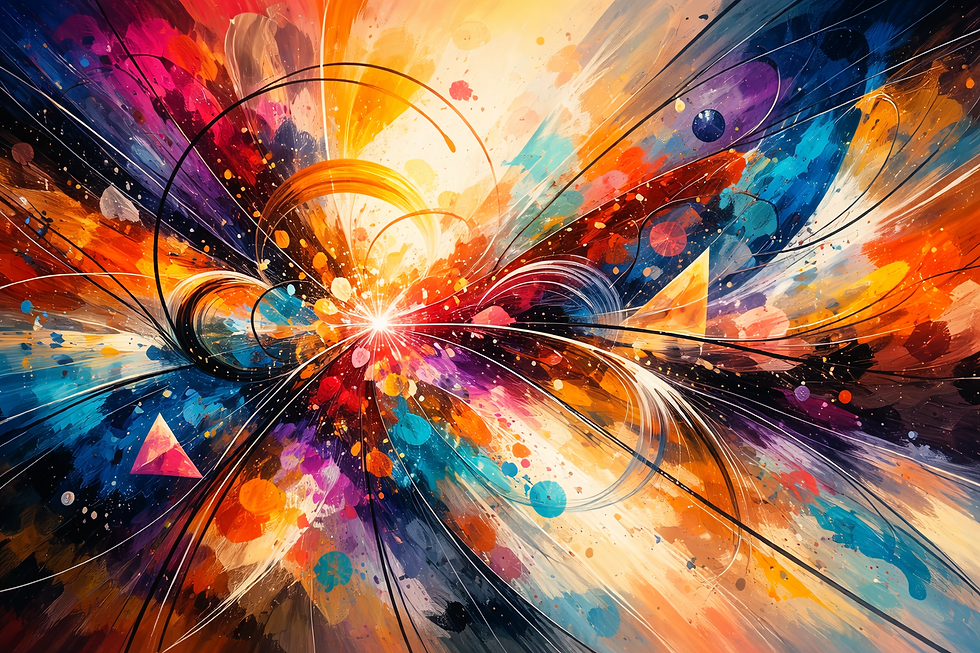
Abstract Painting Composition
Abstract art relies heavily on composition because it does not depend on realistic subjects.
In abstract paintings:
Balance of color and shape becomes the main structure
Movement is created through lines, textures, and contrast
The focal point is often emotional rather than literal
Negative space becomes just as important as the painted areas
Abstract composition is about energy and harmony.
When it works, it feels alive. When it fails, it can feel confusing or unfinished.

Landscape Painting Composition
Landscape composition focuses on depth and perspective.
Key elements include:
Foreground, middle ground, and background balance
Leading lines such as rivers, paths, or horizons
Atmospheric perspective and light direction
A natural focal point such as a tree, mountain, or sunset
A strong landscape composition invites the viewer into the scene.
It creates the feeling that you can walk into the painting and experience the space.

Portrait Painting Composition
Portrait composition is centered on the subject — usually a person or animal.
Important elements include:
Placement of the subject within the frame
Eye direction and emotional expression
Balance between subject and background
Lighting and contrast around the face
Portrait composition determines emotional impact.
Even a slight shift in placement or lighting can change the entire mood of the work.
Why Perfect Composition Is Impossible
Here is a truth many artists eventually discover:
Perfect composition is impossible.
Why?
Because composition is not a fixed formula.
It changes depending on:
The viewer’s perception
Cultural background
Emotional state
Personal interpretation
Artistic intention
What feels balanced to one person may feel chaotic to another.
What feels minimal to one collector may feel empty to someone else.
Art is not mathematics.
It is a living dialogue between artist and viewer.
This means composition can always be refined, but never truly perfected.

My Personal Story: Painting Without Understanding Composition
When I began painting seriously again, it was not from a place of technical study.
It was from a place of healing.
After losing my freelance work as a meditation music producer and therapist, I returned to painting as a form of therapy to relieve stress and reconnect with myself. Painting became my way of expressing emotions I could not always put into words.
I painted freely.
I painted intensely.
I painted a lot.
But I did not fully understand composition.
I created many first edition original paintings driven by emotion rather than structure.
I focused on color, texture, and feeling — not on balance, depth, or focal points.
At the time, I believed that pure expression was enough.
And emotionally, it was. Those paintings helped me heal and grow as an artist.
However, when it came time to present these works to collectors, I faced a challenge.
Many of my early first edition paintings were difficult to sell.
Not because they lacked emotion or authenticity — but because their compositions were not always strong or balanced.
That was a difficult realization.
Using AI to Identify Composition Errors
But all was not lost.
Instead of abandoning these works, I turned to technology.
I began using AI tools to analyze my paintings objectively — something that is often difficult for an artist to do with their own work. These tools helped identify:
Imbalance in visual weight
Weak focal points
Depth and perspective issues
Color distribution problems
Areas where movement felt blocked
For the first time, I could see my paintings not just emotionally, but structurally.
This opened a new door.
Correcting the Compositions Digitally
Using these insights, I carefully corrected composition errors digitally while preserving the spirit and emotion of the original works.
I did not change the soul of the paintings.
I refined their structure.
The corrected versions revealed what the paintings were always meant to become — balanced, harmonious, and visually complete.
From this process, a new offering was born.
Introducing Collector Edition Limited Prints
While the original first edition paintings remain one-of-a-kind artworks, I now offer collector edition limited prints based on the digitally corrected compositions.
These editions are:
Carefully refined for strong visual balance
Enhanced for depth and harmony
Limited in number for exclusivity
Created for collectors who appreciate both emotion and structure
This means that even if a first edition original has compositional challenges, its evolution continues through a refined collector edition print.
Nothing is wasted.
Every painting grows.
A New Perspective on Composition
Today, I see composition not as a rigid rule — but as a journey.
I painted first from emotion.
Then I learned structure.
Now I combine both.
Composition matters deeply in painting, whether abstract, landscape, or portrait.
But it is also something we continue learning throughout our artistic lives.
For collectors, this journey adds another layer of meaning.
Each work tells not only a visual story — but also the story of artistic growth, discovery, and transformation.
And sometimes, the most beautiful compositions are not the ones that begin perfectly…
but the ones that evolve into balance over time.


Comments